
In 2025, the French digital advertising market reaches €12.4 billion, up +11% (vs +16% in 2024), according to the E-Pub Observatory of the SRI and Udecam.
A slightly slower pace, but still double-digit, in a context where French GDP remained at +0.9% in France.
For comparison, the market was worth around €6 billion pre-Covid. It has therefore almost doubled in a few years.
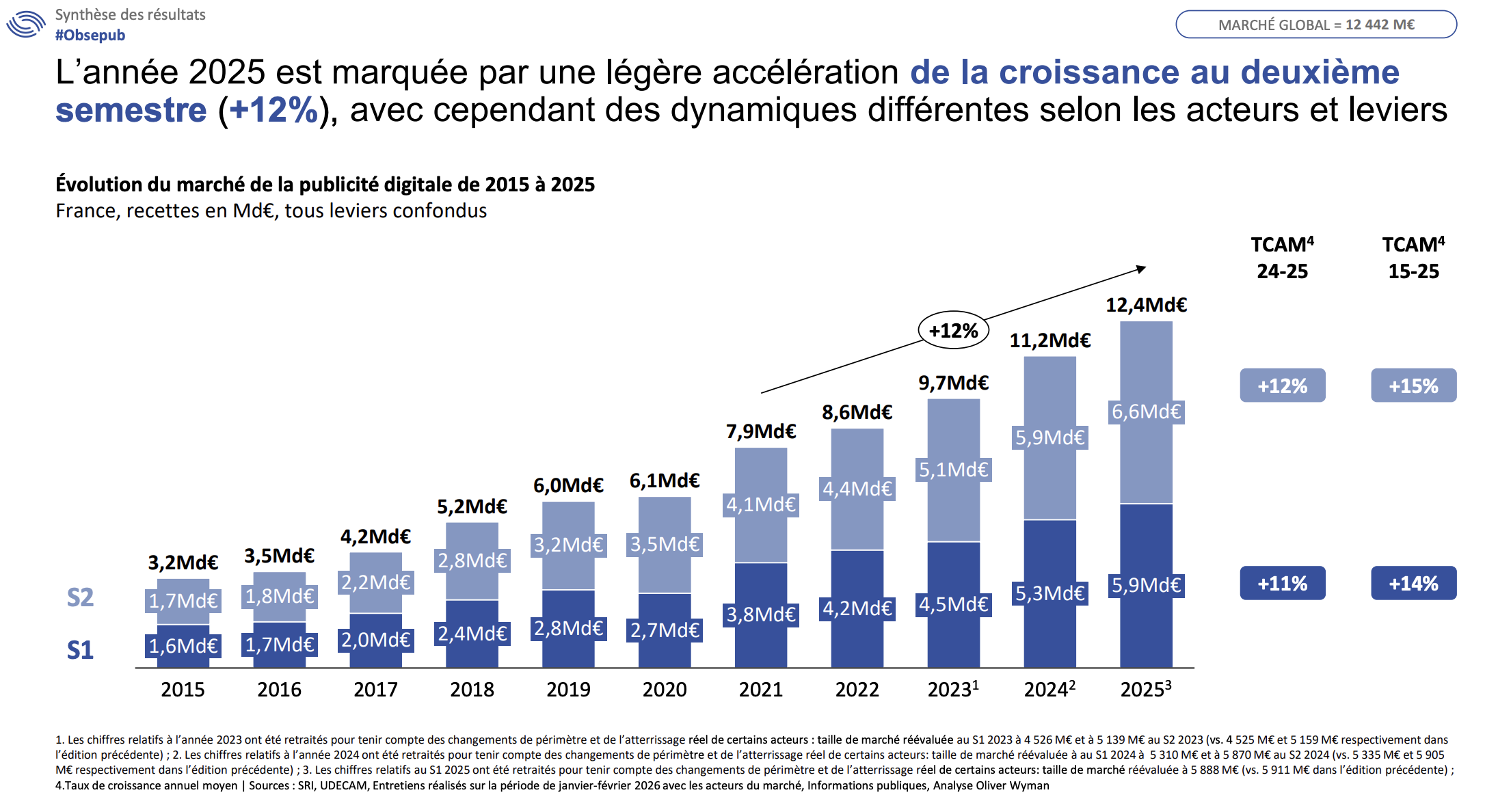
Digital is no longer an optimisation channel: it has become the backbone of media strategies. But behind this solid growth, the fault lines are widening.
Social widens the gap
Social remains the main driver of digital growth. On its own it captures 44% of the market’s total growth and grows +15%, above the market average, ahead of Retail Media and Display (including video and YouTube).
With a 34% market share (€3.4bn), it is ahead of SEA with 31% and €3.91bn, then Display (including YouTube) at €1.98bn.
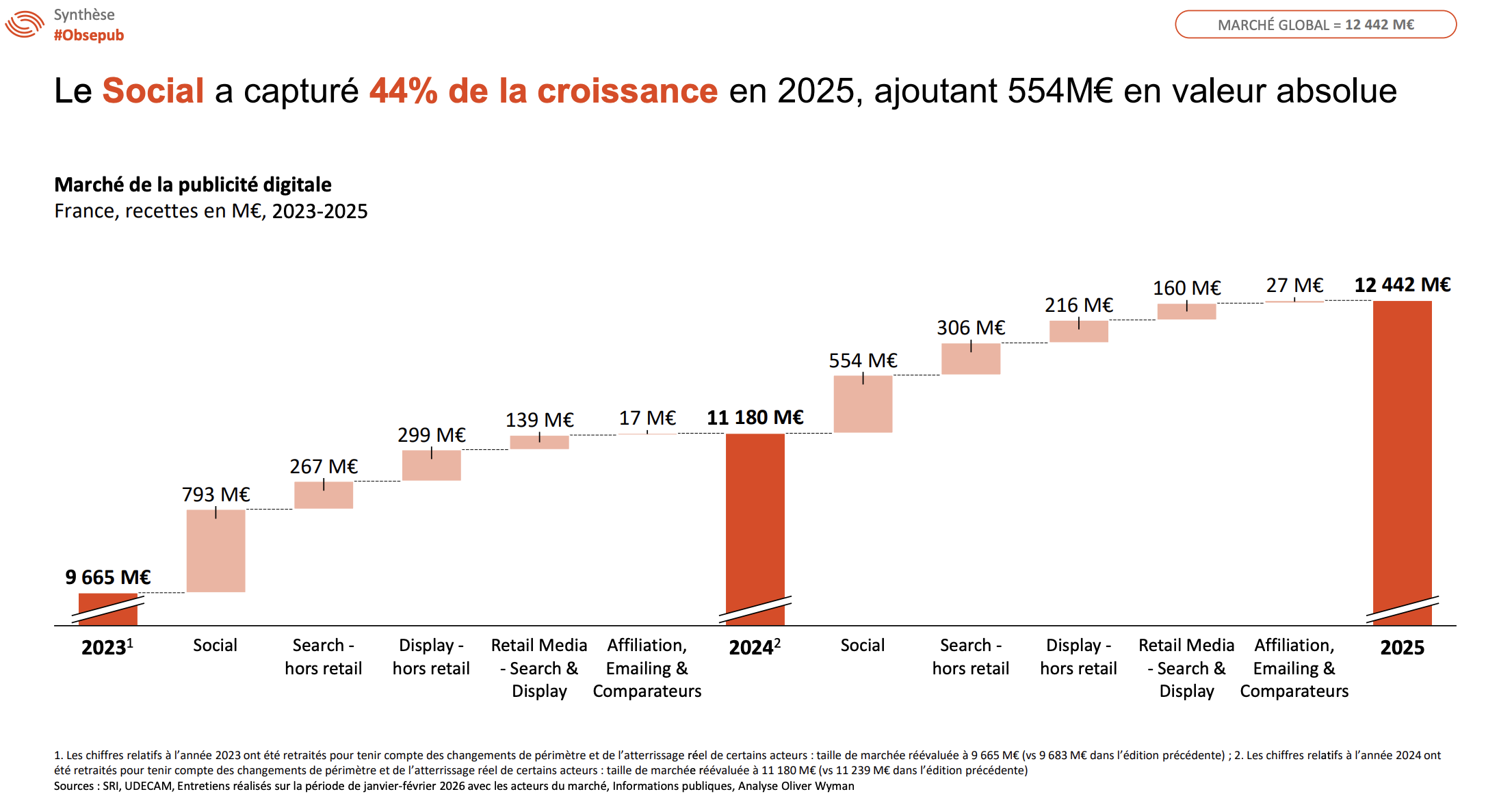
SEA continues to show solid growth (+8%), but below the digital average.
The trajectory is clear: growth concentrates where platforms master simultaneously attention, data, performance and now video.
The rise of social search and the explosion of video (+22% in Paid Social) reinforce this dominance.
Video: the king format
Video has become the market’s cross-cutting engine:
– 60% of Display investments
– 58% of Social investments
– +22% growth in Paid Social vs the previous year
– 1/3 of the digital market now concentrated on this format.
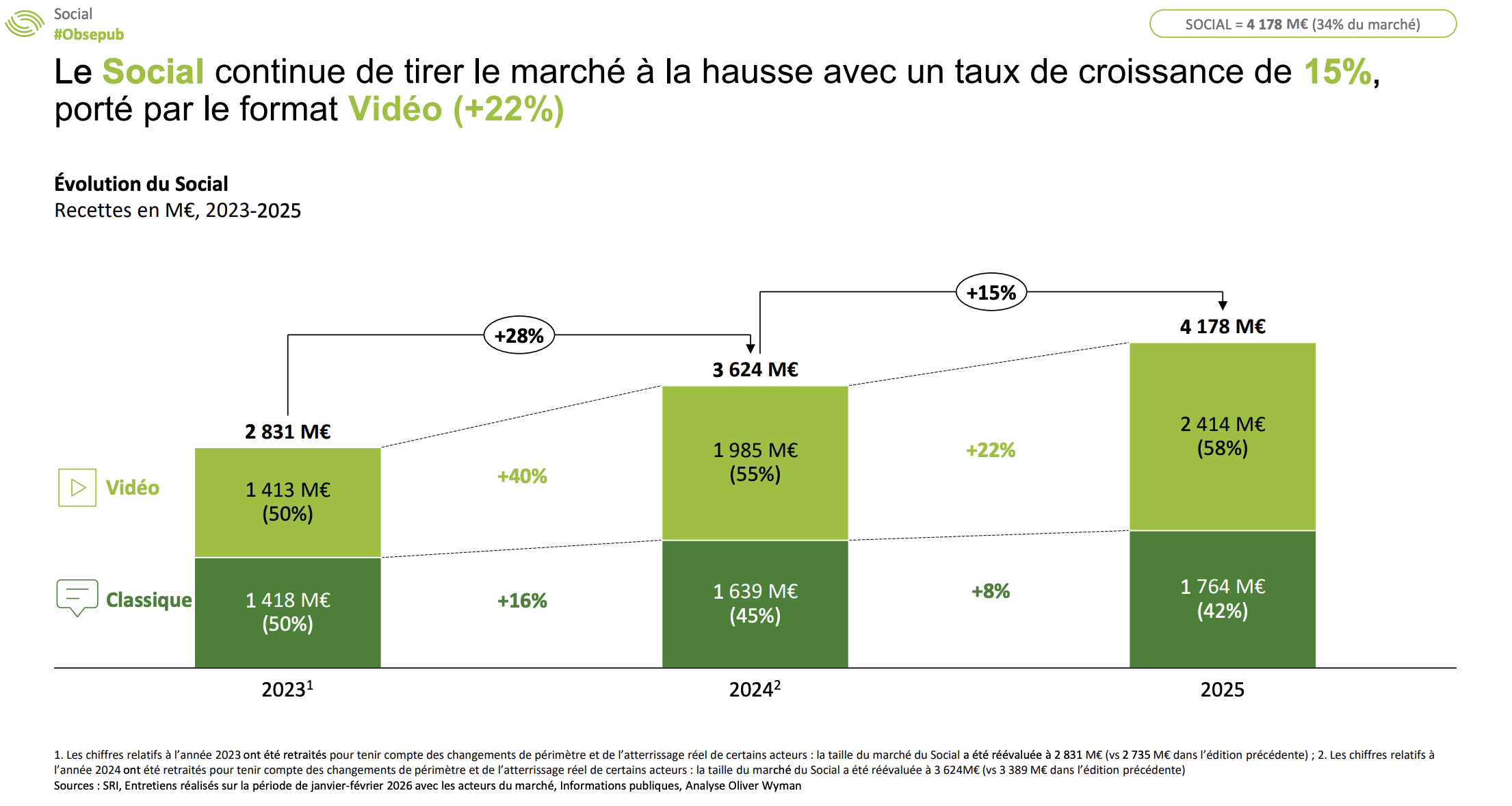
Short, vertical, interactive, premium or shoppable, video now structures attention strategies.
But this dominance raises a question. If everyone invests in video, where does differentiation still lie? The battle is no longer played solely on format, but on: creative quality, data relevance, the ability to generate memorisation, not just clicks.
Hyper-concentration of investments
Eight platforms (Meta, Google/YouTube, Amazon, TikTok, LinkedIn, Snap, X, Pinterest) now capture 76% of investments and 83% of growth.
Their average growth reaches +13%, versus +8% for European players, whose share falls to 18% of the market.
The transformation is structural: market growth mainly benefits integrated ecosystems able to control the whole value chain: media offer, first-party data and activation capabilities.
2026: towards +12%?
Forecasts anticipate growth of around +12% in 2026.
But the stake is no longer limited to growth. It becomes strategic: where to invest to create a real competitive advantage?
How to differentiate in an ecosystem dominated by a few large platforms that concentrate attention and budgets?
How to arbitrate between short-term performance-oriented set-ups and those that build brand value over the long term?
How to emerge when video has become a standard and no longer a differentiating lever?
In a market driven by data, AI and automation, optimisation tools are becoming widespread. Technical performance tends to become uniform.
The difference is therefore no longer made solely through media buying, but through investment strategy and the ability to strengthen the power of the brand: creating preference, justifying value and anchoring the brand lastingly in audiences’ minds.
Source: SRI / UDECAM – Link to the study
Going further: our strategic consulting offer.
On the same topic: « Social Commerce Report 2024 – Executive » and « How to measure the performance of social campaigns today ».
Keywords