
The various upcoming changes to cookies (Privacy, iOS14, Chrome, etc.) will mean new challenges for advertisers in exploiting this data within Social media ecosystems. While retargeting and personalisation capabilities will be limited, there is a major stake in strengthening advertisers’ position by not renting data but making them its owners. Social networks can be real accelerators for First Party data, notably through the native “Lead Ad” format on Facebook & Instagram, properly applied. We detail the three key points to anticipate and a practical case.
Focus on the useful information to optimise collection costs
The Lead Ad is a native Facebook & Instagram form that lets you collect a list of information of your choice (link). Depending on your database, you can choose the items you want to collect. The longer the form, the higher the cost per lead is likely to be. So it is better to focus on the useful information you will actually use (Last name, First name, Email address, Phone number, for example).
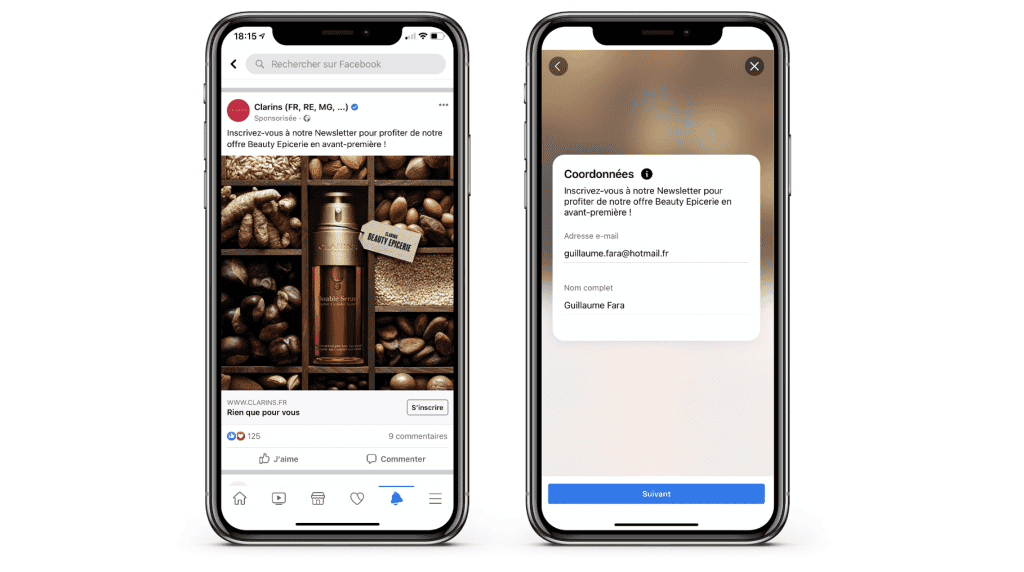
How to use the Lead Ad to boost your acquisition?
Example of a Lead Ad developed for Clarins France
Use the Lead Ad with audiences identified on a behaviour
First-party collection can be broad on the basis of interests, but if you want an ROI-driven approach, we recommend reaching audiences on a behaviour, and developing the link with your site can be interesting:
- Lead Ad retargeting of site abandoners: Use the Lead Ad to retarget site visitors who had a qualified visit (Top Visitors or Add to Cart). This information can be reused in your CRM/PRM to offer them a purchase incentive, for example, or to be retargeted by a retargeting / DPA campaign.
- Guerrilla on competitor interests: You can choose to specifically address audiences engaged in your competitors’ universe to offer them an offer in exchange for data collection.
- Reactivating lost customers: You can choose to address your non-openers of more than 6 months, for example, or your inactive high-value customers, to try to requalify your database with up-to-date phone number data.
How to measure the ROI of your actions?
To measure the ROI of First Party collection actions, we recommend isolating the collected audiences in your CRM to have specific tracking of these audiences. There are then two ways to track performance: either by studying the sales made on these populations through newsletters, or by looking at the responsiveness of the audiences in media campaigns and the associated ROI compared with standard campaigns.
A practical case mixing offer & ROI measurement
For an E-commerce Fashion advertiser, we used the Lead Ad to retarget abandoning audiences to announce the start-of-year Outlet. Sign-up allowed people to receive the offers and the access page in advance. The newsletter sent managed to generate an ROI of 4.8 (Total revenue / Total lead collection cost).
Going further: our Data & AI expertise.
On the same topic: « Social CRM: how to nurture and enrich your 1st-party data to become a business accelerator » and « Social CRM: how to retain the new customers and audiences acquired during lockdown? ».
Keywords