
We must admit before starting: at tigrz we have a passion for chatbots. Inherited from a recent past in which we had rather fun, with a few failures and a few successes, developing chatbots on Facebook Messenger or Twitter to support brand strategies. From a journalist chatbot for an energy player, to a car configurator & test-drive booking agent for automotive players. Each time, a few recurring elements made it possible to identify the keys to success of an approach integrating a chatbot and to understand that the trend was here to stay.
To start thinking about the chatbot, you have to consider it as a conversational tool to integrate into your customer journey and to support with a dedicated media plan. Here are 4 key elements to develop a Messenger strategy:
Don’t bet on organic
A chatbot can live organically with good integration in a website (via the Facebook API, for example), but it will perform much better if you integrate from the start a media strategy to go and find qualified users or to use it as a retargeting channel for site visitors, for example.
Make a good impression
As on a website – or a first meeting – it is important to make a good impression. The welcome message that opens the post-click conversation determines whether you can then keep addressing the user organically. You must therefore be concise and engaging, quickly displaying the promise. Integrating a carrot such as a contest, discount vouchers or coupons, etc. is good practice as long as the audience addressed is qualified from the start.
Guide the choice
One rule works every time on the Internet: tell people what you expect of them. In this sense, we have seen many conversational chats that wait for internet users to talk to them fail. It is better to favour mechanics and scenarios integrating buttons, closed questions and journey choices (in the form of a carousel, for example), to maximise interaction and make it easier for users to progress. The conversation is admittedly pre-fabricated, but it will often have the merit of ending in an action.
Tagging the conversation
And we loop back to the starting point. It is important, as on a site or even an app with an SDK, to tag the conversation with Facebook events at key moments of the conversation (choice of an appointment, products, add to basket, redirect to the site to complete the purchase, etc.). The idea is to be able both to retarget abandoners and re-engage them at specific moments of the discussion, and to create lookalike profiles on converters to go and find high-value profiles.
The chatbot as a performance engine
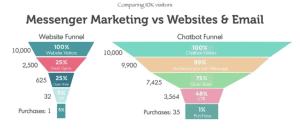
A recent article published on Buffer and shared by lepetitweb illustrated a key element for a brand engaging in retargeting or traffic acquisition strategies:
- Generating mobile traffic to your site means accepting sustained bounce rates on unidentified traffic. You do pay for clicks, but the final costs per visit can be higher, even more so on mobile.
- Traffic on the site remains non-logged-in traffic and can therefore only be re-used through paid retargeting. Conversely, conversations initiated on Messenger make it possible to keep a hook to re-engage audiences organically at first, then through advertising.
We share here the illustration, which we find very accurate and which helps understand how the chatbot can be a performance engine.
Limited production costs that allow you to test and then accelerate
Finally, a democratisation of chatbots has begun, with restricted development costs. There are indeed many apps or CMSs that let you develop your own chatbots using pre-built templates. There remain constraints to integrate on tagging, and on grammar too depending on sectors or objectives, but the development cost, which could previously be several tens of thousands of euros, can be kept under €10k.
In short, if the expected explosion of Social Commerce in 2020 will be carried by Instagram Shopping, we must not forget Messenger, which can play a key role in:
Product recommendation
Loyalty and repurchase
After-sales support & customer service
If you want to discuss it with us, a human will be able to take care of this at our contact page
Going further. See also tigrz’s Data & AI expertise.
On the same topic: « Social CRM: how to nurture and enrich your 1st-party data to become a business accelerator » and « The rise of AI in content creation: the scheduled end of content creation as we know it? ».
Keywords